

What Is AI Usage Control?

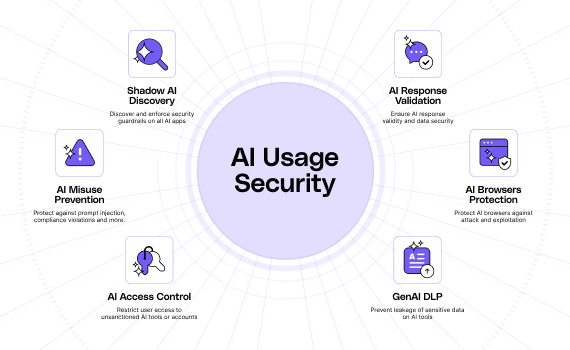
AI Usage Control (AIUC) is a security and governance capability designed to help organizations discover, understand, and control how AI is used across the enterprise.

AI Usage Control is an umbrella term encompassing the various risks and challenges associated with AI usage, such as data loss prevention (DLP), misuse, or unintended behavior. As organizations race to integrate AI into daily workflows, they simultaneously create new pathways for data exfiltration, compliance violations, and security incidents. Effectively managing this new ecosystem requires a strategic approach that moves beyond simple bans and focuses on enabling productivity securely. The core challenge is no longer if AI should be used, but how to govern AI usage responsibly.

The rapid adoption of AI tools has fundamentally altered the enterprise security ecosystem. Employees, seeking to enhance productivity, frequently turn to publicly available AI platforms and third-party extensions, often without the knowledge or approval of IT and security teams. This creates a significant blind spot where sensitive corporate data, from source code and financial reports to personally identifiable information (PII), can be exposed. Without a robust framework for AI usage control, organizations are left vulnerable to a host of emerging threats that traditional security tools are ill-equipped to handle.

The Expanding Scope of AI Risks in the Enterprise

The convenience of GenAI introduces a complex web of AI risks that extend far beyond simple misuse. These risks are not theoretical; they are active threats that can lead to significant financial, reputational, and regulatory consequences. Understanding this new attack surface is the first step toward building an effective defense.

Data Leakage and DLP Failures

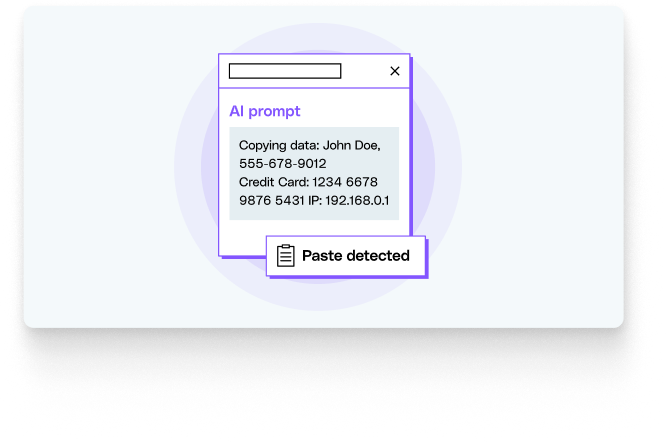
The most immediate risk is data loss. Employees regularly copy and paste sensitive information into AI prompts to generate code, draft emails, or analyze data. This activity, whether inadvertent or malicious, is a primary vector for data exfiltration. Once data is entered into a public large language model (LLM), the organization loses control over it, creating a serious DLP (Data Loss Prevention) nightmare. Traditional DLP solutions, which typically monitor networks and endpoints, often fail to inspect data being pasted into a web browser, leaving this channel completely exposed.

Shadow AI and Unauthorized Usage

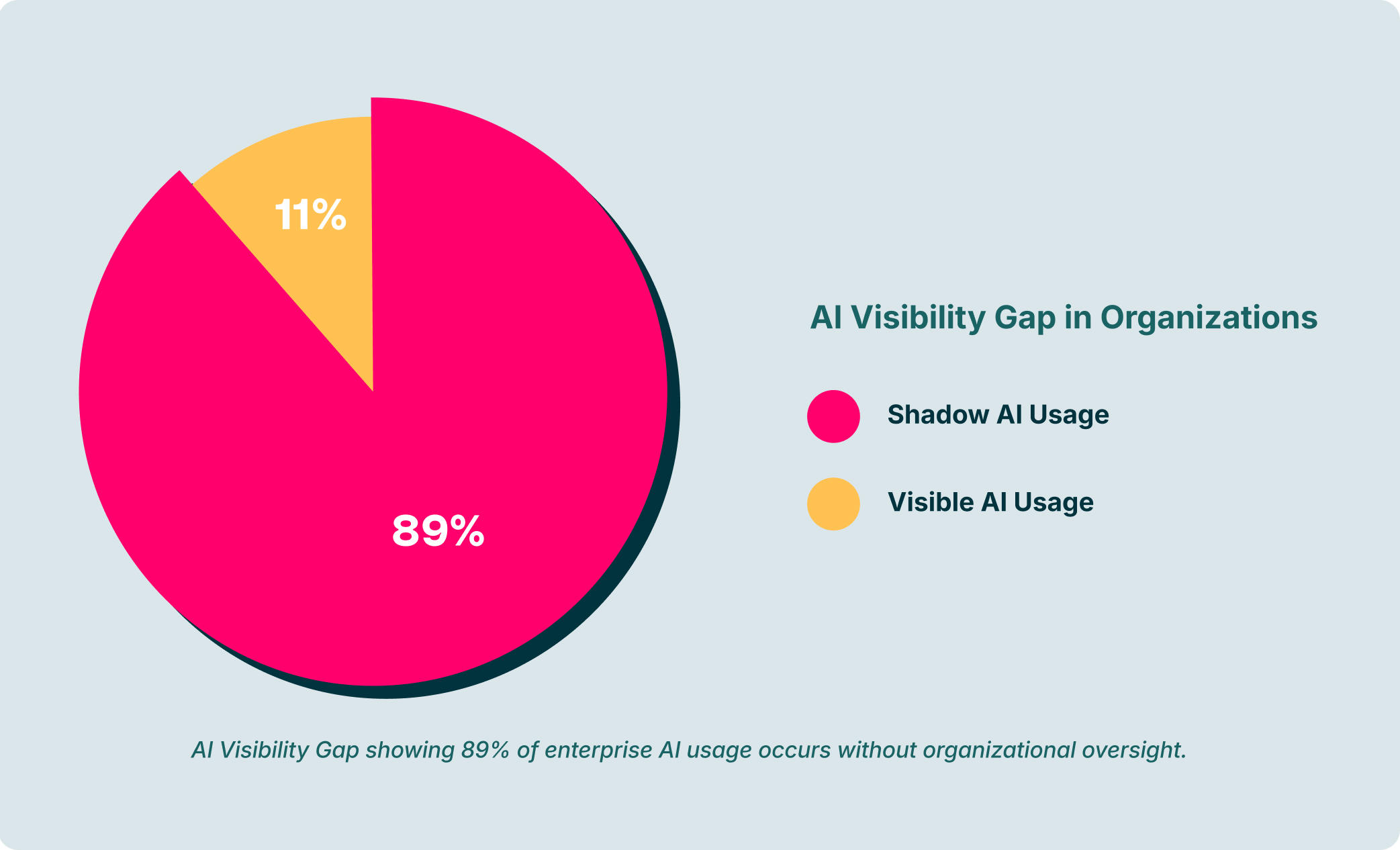
The proliferation of free and specialized AI tools has given rise to “Shadow AI,” a modern variant of Shadow IT. This is the unauthorized AI usage by employees of unvetted applications and extensions that operate outside of the company’s security policies. Each of these unsanctioned platforms has its own privacy policy and security posture, creating a massive governance gap. Security teams often have no visibility into which tools are being used or what data is being shared, making incident response nearly impossible.

Insecure API Integrations

As businesses integrate AI capabilities into their own applications, they create new potential vulnerabilities. A misconfigured API can become an open gateway for attackers to access the underlying AI model and the data it processes. These insecure integrations can allow for the systematic exfiltration of data at scale, often going undetected for long periods. Attackers can also bombard these APIs with queries to cause resource exhaustion, leading to system slowdowns and significant financial costs from metered services.

Risky AI-Powered Extensions

AI-powered browser extensions introduce significant risks due to their often over-permissive nature. Many extensions require access to all browsing activity, clipboard data, or session cookies to function, making them a prime target for exploitation. Vulnerabilities in these plugins can lead to session hijacking, credential theft, and silent data harvesting, where an extension transmits sensitive information to a third-party server without the user’s knowledge.

AI-Generated Threats

Beyond data exfiltration, AI itself can be used to create highly sophisticated cyberattacks. Attackers are now using GenAI to craft convincing phishing emails that mimic legitimate communications, making them much harder to detect. They can also use AI to develop and debug malware that is designed to evade traditional security measures, increasing the overall attack surface for enterprises.

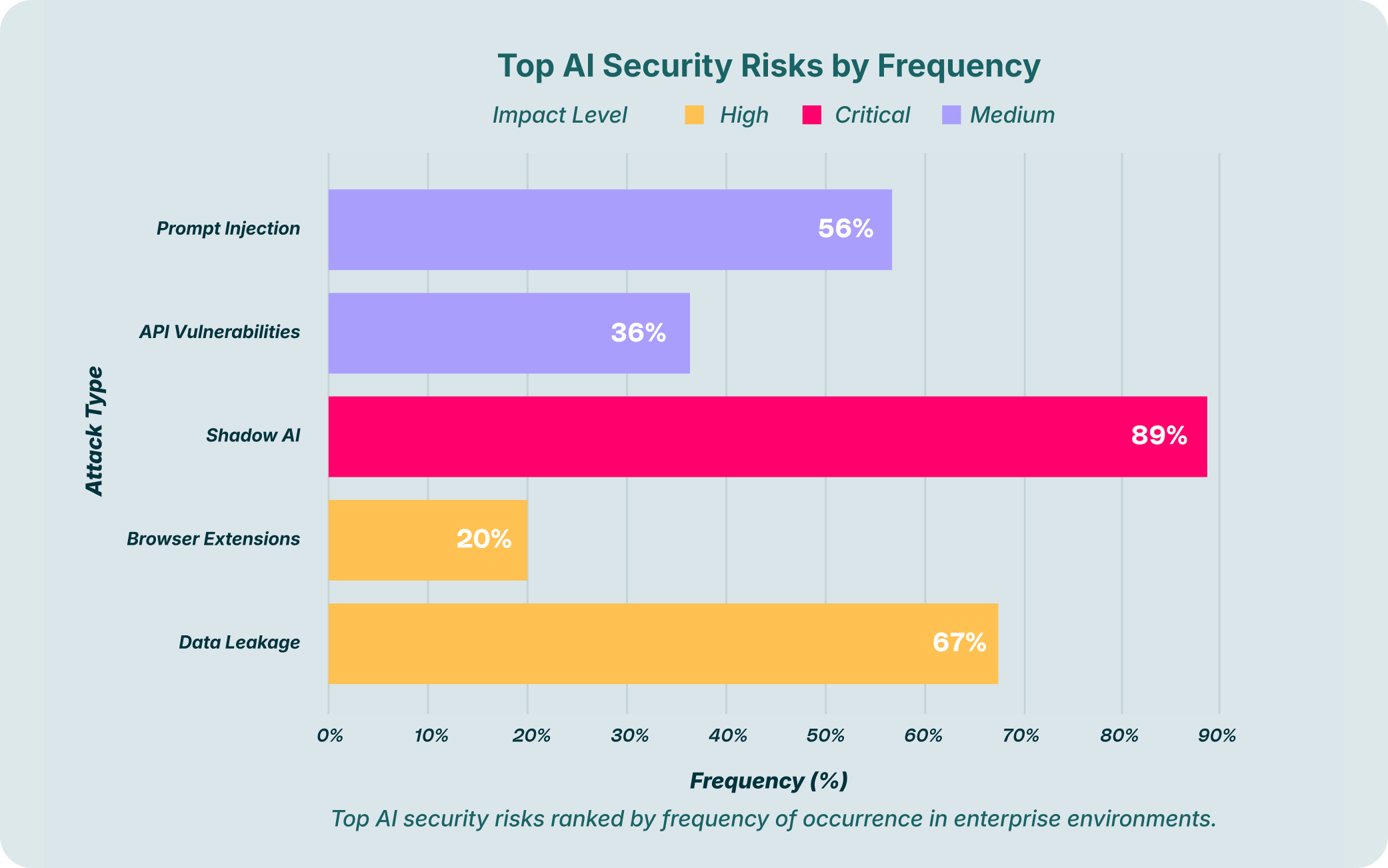
Enterprise AI risk is no longer theoretical, it’s already widespread and growing. Shadow AI emerges as the most frequent and critical risk, driven by employees adopting unapproved AI tools and extensions outside of IT oversight. At the same time, data leakage remains a persistent threat as sensitive information is routinely shared through AI prompts.

API vulnerabilities and prompt injection attacks highlight how AI integrations introduce new technical attack surfaces, while risky browser extensions continue to expose organizations through excessive permissions and hidden data access. Together, these risks show that AI security challenges span users, browsers, APIs, and applications.

Why Traditional Security Is Insufficient for AI Control

Lack of Context

Network and endpoint DLP solutions typically lack the context to understand user intent within a browser. They may see encrypted web traffic but cannot differentiate between a user pasting harmless text into a search engine versus pasting sensitive source code into an unauthorized AI tool.

The Browser Blind Spot

GenAI is predominantly accessed through the web browser, which has become the new frontier for enterprise application access. Security solutions that do not have deep visibility into browser activity cannot effectively monitor or control AI usage.

Binary Block/Allow Limitations

Many legacy tools can only block or allow access to an entire website. This approach is too heavy-handed for AI. Blocking all AI tools stifles innovation and productivity, but allowing them without guardrails invites risk. A granular AI control is needed to allow productive use while preventing dangerous actions.

Benefits of AI Usage Control

Enable AI Innovation Without Risk

AI Usage Control allows employees to use AI tools productively while enforcing guardrails that prevent risky actions. Organizations can move beyond blanket bans and adopt AI safely at scale.

Prevent AI-Driven Data Leakage

By inspecting AI interactions in real-time, AIUC helps stop sensitive data from being shared with public AI tools. This closes critical gaps left by traditional DLP and network-based controls.

Complete Visibility & Governance Over AI Usage

AIUC provides visibility into sanctioned and unsanctioned AI tools, including Shadow AI. This enables consistent policy enforcement, auditability, and stronger enterprise AI governance.

Establishing Robust AI Governance:
A Practical Framework

To address these challenges, organizations need to establish a comprehensive AI governance program. This framework is not just a policy document; it is an operational strategy that combines people, processes, and technology to govern AI usage effectively.

Foundations of AI Governance

Effective AI governance is built on key principles like transparency, accountability, and continuous monitoring. It requires a cross-functional committee with representatives from security, IT, legal, and business units to ensure that policies are balanced and practical. This committee is responsible for defining the organization’s stance on AI and establishing clear policies for its use.

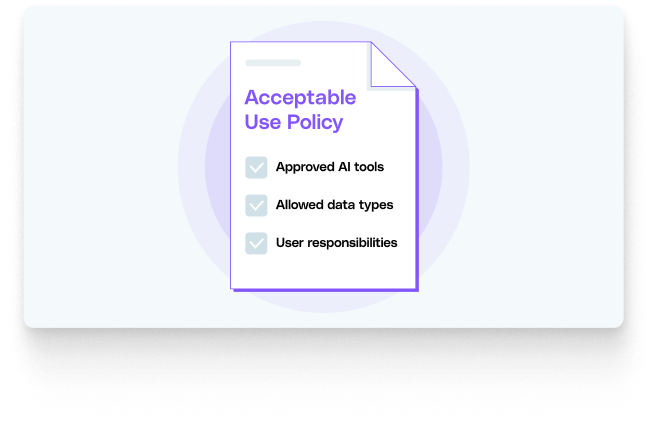
Develop a Clear Acceptable Use Policy (AUP)

Employees need clear guidance on what is and isn’t allowed. The AUP should explicitly state which AI tools are sanctioned, what types of data can be used with them, and the user’s responsibilities for secure AI usage. This policy eliminates ambiguity and sets the foundation for secure AI adoption.

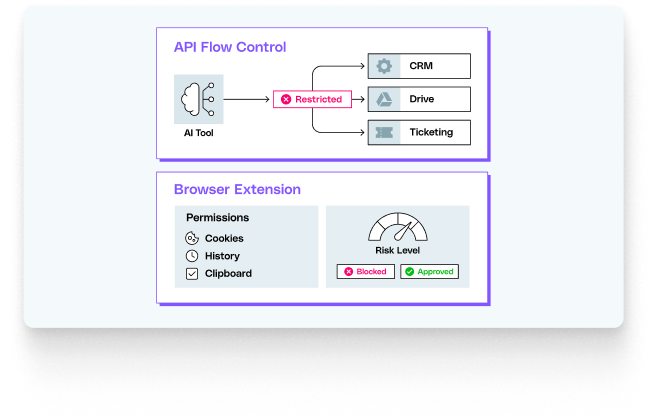
Monitor and Control the API and Plugin Ecosystem

An effective AI governance framework must also address the risks posed by the broader AI ecosystem. This includes implementing controls at the API level to restrict the flow of data between AI tools and other applications. Additionally, security teams need the ability to audit AI-powered browser extensions, assess their permissions, and block any that are unapproved or deemed risky.

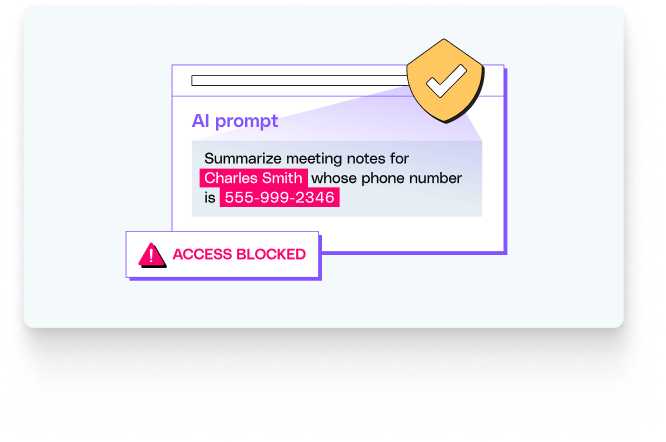
Deploy Browser-Level AI DLP

Since most GenAI interactions happen in the browser, a browser-level DLP solution is a critical control point. These solutions can inspect user interactions in real-time, allowing them to detect when sensitive data is being entered into AI prompts. Based on policy, they can then block the action, redact the sensitive information, or alert the security team before the data is exposed. This provides an essential layer of protection that traditional tools miss.

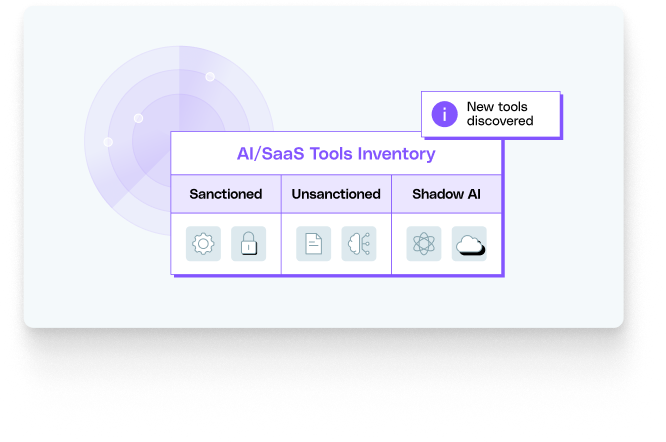
Achieve Full Visibility and Discovery

You cannot govern what you cannot see. The foundational step in any AI usage control strategy is to conduct a thorough inventory of all AI tools being used across the organization, especially Shadow AI. This requires technology that can provide a continuous audit of all SaaS and AI application usage, including tools accessed within the browser.

Implement Risk-Based Access Controls

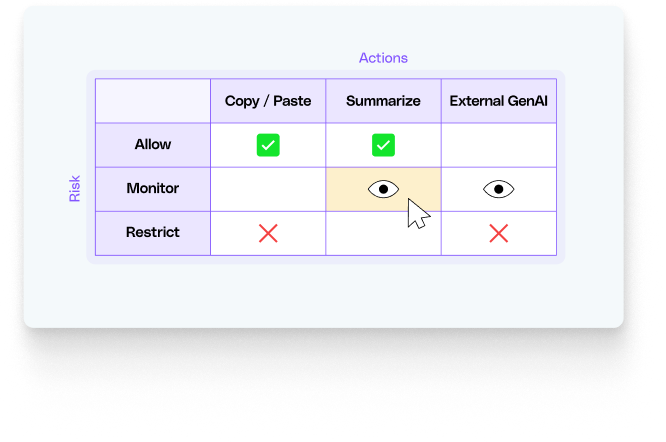
Instead of blocking all AI, a risk-based approach is more effective. This involves applying granular controls that allow low-risk use cases while restricting high-risk activities. For example, a company might permit employees to use a public GenAI tool for general research but block them from pasting any data classified as PII or intellectual property. This nuanced approach to AI control requires a solution that  has  deep visibility into user actions.

The Role of an All-in-one Platform in AI Usage Control

To implement this kind of granular, context-aware security, organizations are increasingly turning to solutions like LayerX . By operating directly within the browser, LayerX provides the deep visibility and real-time control needed to manage modern AI risks.

Imagine a scenario where a marketing employee is using an unauthorized AI tool to help draft a press release. They attempt to paste a document containing unannounced financial figures and customer names. A traditional security solution would likely be blind to this action. However, a browser-level solution like LayerX can:

Analyze the Action

Detect the paste action into the web form in real-time.

Inspect the Data

Identify the sensitive keywords, PII, and financial data within the text.

Enforce Policy

Instantly block the paste action from completing, preventing the data from ever reaching the external AI server.

Educate the User

Display a pop-up message informing the user of the policy violation and guiding them toward a sanctioned AI tool.

This approach allows organizations to govern AI usage without hindering productivity. It transforms a static policy document into an active defense mechanism, enforcing AI control directly at the point of risk. LayerX enables organizations to audit all SaaS and GenAI usage, apply risk-based policies, and prevent data leakage from both sanctioned and unsanctioned tools.

From Chaos to Control in the AI Era

AI usage control is a critical discipline for the modern enterprise. It is not about restricting innovation but about creating a secure environment where it can flourish. The proliferation of GenAI tools has introduced a new paradigm of risks, from data leakage through Shadow AI to insecure API integrations and malicious browser plugins. Traditional security tools are simply not equipped to handle this dynamic and browser-centric threat ecosystem.
Effective AI governance requires a new strategy centered on visibility, granular control, and real-time prevention. By establishing clear policies, deploying browser-level DLP, and leveraging advanced solutions to monitor and control the entire AI usage lifecycle, organizations can manage their AI risks proactively. This allows them to balance productivity with protection, enabling employees to use AI confidently and securely.

AIUC table comparison of LayerX with legacy solutions 

Control The Last Mile of User Interaction 
No changes to User Experience
Tamper / Bypass Proof
No IT Headaches
Scalable
All apps, all user activity, all data
Keep your browser; doesn’t change the user experience
Multi-level tampering protections; coverage for all browsers
Simple deployment, not infrastructure changes
Simple to deploy with no user pushback
SSE/SASE
Impacted by encryption, limited app coverage, requires APIs / connectors
Adds latency; requires VPN/ZTNA outside of the perimeter
Vulnerable to certificate pinning, VPNs and remote users
Complex to configure and define security rules
Change network + deploy VPN/ZTNA clients on remote users
Local Proxy
Limited visibility to apps and non-HTTP channels
Slows down activity, resource intensive, breaks easily
Easily bypassed by switching networks and/or VPN, tunnels, etc.
Complex software installation, configuration; breaks easily
Scale linearly in cost and resource utilization; AI usage scales exponentially

AIUC table comparison of LayerX with legacy solutions 

Control The Last Mile of User Interaction 

SSE/SASE

Impacted by encryption, limited app coverage, requires APIs / connectors

Local Proxy

Limited visibility to apps and non-HTTP channels
All apps, all user activity, all data

No changes to User Experience

SSE/SASE

Adds latency; requires VPN/ZTNA outside of the perimeter

Local Proxy

Slows down activity, resource intensive, breaks easily
Keep your browser; doesn’t change the user experience

Tamper / Bypass Proof

SSE/SASE

Vulnerable to certificate pinning, VPNs and remote users

Local Proxy

Easily bypassed by switching networks and/or VPN, tunnels, etc.
Multi-level tampering protections; coverage for all browsers

No IT Headaches

SSE/SASE

Complex to configure and define security rules

Local Proxy

Complex software installation, configuration; breaks easily
Simple deployment, not infrastructure changes

Scalable

SSE/SASE

Change network + deploy VPN/ZTNA clients on remote users

Local Proxy

Scale linearly in cost and resource utilization; AI usage scales exponentially
Simple to deploy with no user pushback

AI Usage Control Resources

AI Usage Control – FAQs

What is AI Usage Control (AIUC) in enterprise security?

AI Usage Control (AIUC) is a security and governance capability that helps organizations discover, understand, and control how AI tools are used across the enterprise. It reduces data leakage, misuse, and compliance risk while enabling responsible AI adoption.

Why is AI Usage Control becoming a new security category?

AI introduces risks that existing security tools were not designed to handle, especially within browser-based workflows. AIUC addresses these gaps by focusing specifically on AI interactions, usage patterns, and data exposure risks.

Why do organizations need AIUC now?

Traditional security tools can’t see or control AI usage inside web browsers or across modern AI workflows, creating blind spots where sensitive data can be exfiltrated, compliance rules broken, and security risks introduced. AIUC fills this gap with visibility and control.

How is AI Usage Control different from SSE or CASB?

SSE and CASB solutions focus primarily on network traffic and application access. AI Usage Control focuses on user actions and data interactions within the browser, where most AI risk actually occurs.

Why is the browser critical for AI Usage Control?

Most AI tools are accessed through the browser, making it the primary point where AI interactions occur. Browser-level controls provide the context and granularity needed to govern AI usage effectively.

What kinds of AI risks can AI Usage Control help mitigate?

AIUC helps address risks such as data leakage to public AI services, shadow AI usage, insecure API integrations, risky AI extensions, and AI-generated threats like sophisticated phishing or automated malware creation.

Does AIUC impact user productivity?

AIUC is designed to balance security and productivity by allowing low-risk AI actions while blocking or redacting risky ones instead of simply banning all AI usage. That’s why it does not negatively impact user productivity.

What should organizations look for in an AI Usage Control solution?

Organizations should look for visibility into AI usage, browser-level enforcement, data loss prevention, extension and API controls, and flexible risk-based policy management.

Will AI Usage Control impact employee privacy?

AIUC focuses on monitoring actions relevant to risk and governance; most private data processing happens locally in the browser and isn’t transmitted externally, minimizing privacy concerns while enabling security oversight.

Does AIUC only apply to large enterprises?

While AIUC is vital for large organizations, any business using AI tools, especially those handling sensitive or regulated data can benefit from structured AI usage governance.

The AI Interaction
Security Platform

With LayerX, any organization can secure all AI interactions across any browser, app and IDE and protect from all browsing risks