
Genspark represents a new generation of AI browsers designed to transform how users interact with web content through artificial intelligence integration. While Genspark promises enhanced productivity with features like Super Agents, on-device AI processing, and automated workflows, this AI browser introduces significant Genspark security challenges that enterprises cannot ignore. Recent security research has exposed critical Genspark vulnerabilities that place users at substantially higher risk compared to traditional browsing solutions.
AI browsing technologies like Genspark operate fundamentally differently from conventional browsers. These browsing assistants actively process, analyze, and interact with web content using embedded AI models, creating an expanded attack surface that malicious actors can exploit. Understanding Genspark risks and AI browsing vulnerabilities is essential for organizations evaluating these emerging technologies as part of their digital infrastructure.
Genspark Browser: Security Architecture and Design Approach
Genspark builds its foundation on the Chromium framework, which provides baseline compatibility with existing web standards. However, the AI browser significantly diverges from traditional implementations by incorporating multiple AI models, automated agent systems, and extensive third-party integrations through its Model Context Protocol (MCP) marketplace.
The Genspark architecture processes webpage content through multiple AI models simultaneously, enabling real-time text analysis, visual recognition, and semantic comprehension. This design choice, while enabling powerful automation capabilities, creates multiple points where Genspark vulnerabilities can emerge. The browser’s Super Agent functionality grants AI systems extensive permissions to interact with user data, connected services, and authenticated sessions.
Genspark security implementation shows concerning gaps when compared to established browsers. The platform claims to prioritize privacy with features like local data processing when feasible and network-level ad blocking. However, independent security auditing remains notably absent, leaving critical questions about the browser’s defensive capabilities unanswered.
The integration design allows Genspark to connect with over 700 MCPs, ranging from social media platforms to database connectors and API workflow creators. While this extensibility delivers powerful automation, each integration represents a potential vulnerability vector that attackers could exploit to compromise user data or execute unauthorized actions.
User experience in Genspark prioritizes seamless AI interaction over security friction. The browser automatically processes webpage content, interprets user intent, and executes multi-step workflows with minimal user confirmation. This “low-friction” approach, while convenient, reduces the security checkpoints that might catch malicious activities before they cause harm.
Critical Genspark Security Risks and Vulnerabilities
Inadequate Phishing Protection
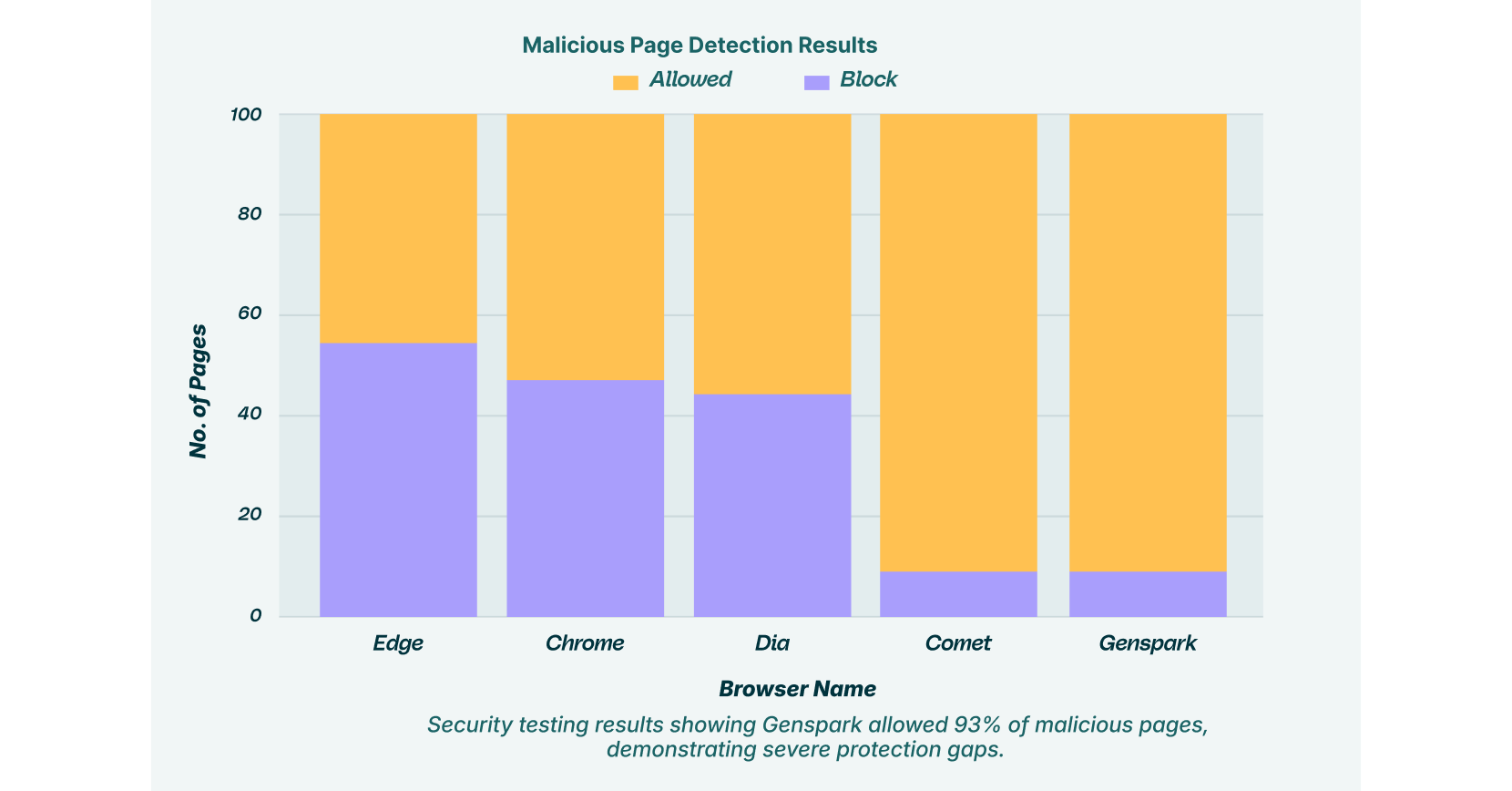
The most alarming Genspark vulnerability involves catastrophic failures in phishing attack prevention. Independent security testing by LayerX revealed that Genspark blocked only 7% of known phishing websites when tested against 100 active phishing campaigns. This 93% failure rate places Genspark users at dramatically higher risk compared to traditional browsers.
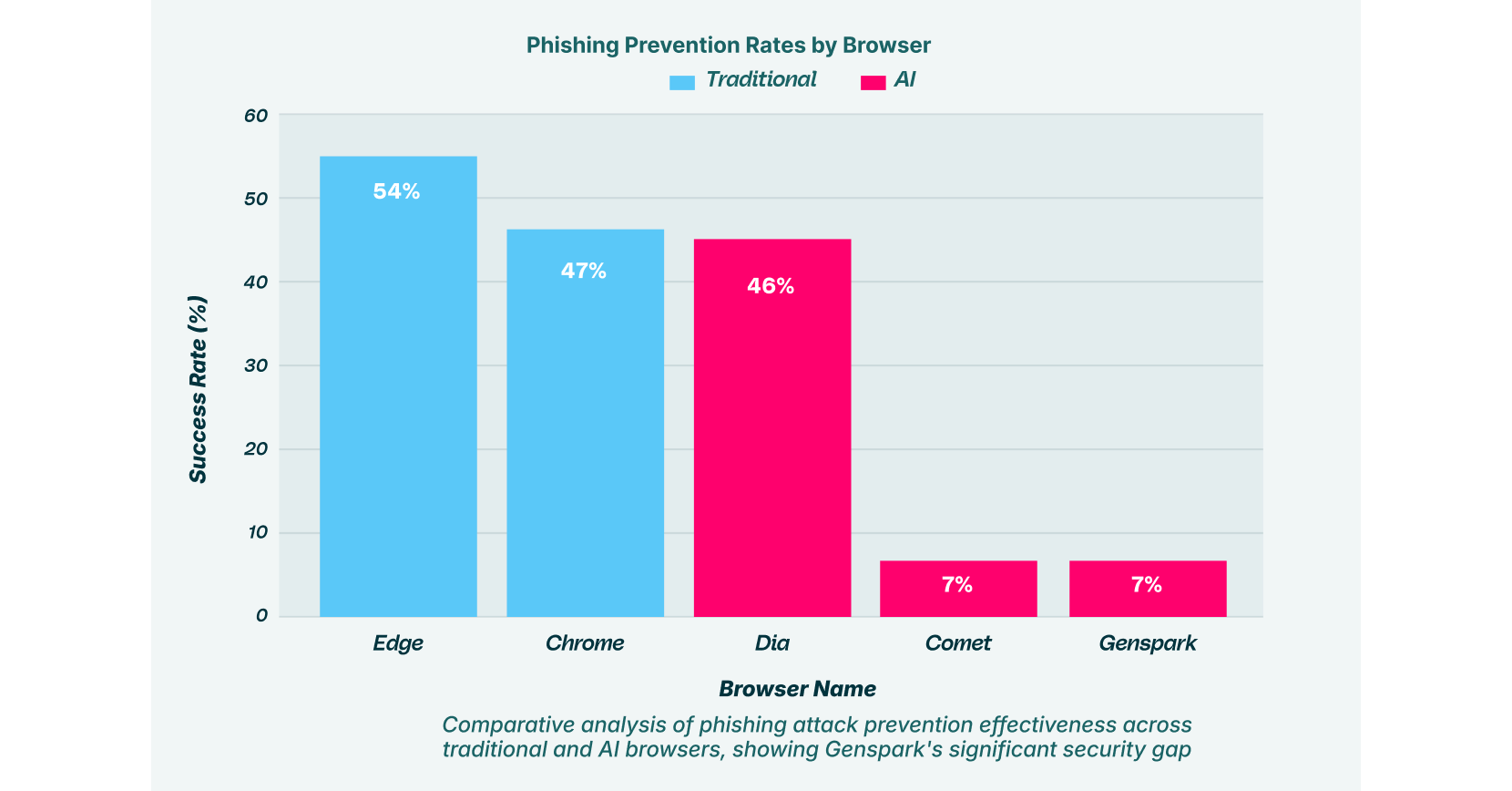
Research indicates that Genspark does not implement Google’s Safe Browsing protections, which are standard security features available to Chromium-based browsers. While Edge successfully blocked 54% of phishing attempts and Chrome stopped 47%, Genspark allowed the vast majority of malicious pages to load without warning. This represents a fundamental Genspark security failure that exposes users to credential theft, financial fraud, and malware distribution.
The few pages Genspark did block were stopped using insecure connection pages rather than active phishing identification. This network-level blocking occurs only when technical errors arise, not from recognizing malicious intent. Attackers using properly configured HTTPS certificates can bypass even these minimal protections entirely.
Prompt Injection Attacks
Genspark vulnerabilities extend to sophisticated prompt injection attacks that exploit how the AI browser processes webpage content. When Genspark summarizes or interacts with web pages, it cannot distinguish between legitimate content and malicious instructions embedded by attackers. This fundamental design flaw allows threat actors to hijack the AI’s behavior through carefully crafted prompts hidden within seemingly innocuous web content.
Attackers can embed malicious instructions using invisible text (white text on white backgrounds), HTML comments, or other hidden elements that Genspark processes as commands. When users ask Genspark to summarize a compromised page, the AI executes these hidden instructions with the user’s full privileges across all authenticated sessions.
The implications for AI browsing risks are severe. A single prompt injection attack could instruct Genspark to navigate to the user’s banking site, extract saved passwords, access Gmail or Calendar data, or exfiltrate sensitive corporate information to attacker-controlled servers. Unlike traditional web vulnerabilities that affect individual sites, prompt injection enables cross-domain access through simple natural language instructions.
Data Exfiltration Through AI Processing
Genspark processes substantial amounts of user data through its AI systems, creating significant AI browsing vulnerabilities related to data leakage. When users interact with the AI browser, they routinely paste sensitive information into prompts, upload confidential documents for analysis, or allow the Super Agent to access connected services.

The browser’s design enables AI agents embedded within Genspark to operate with full user privileges across banking, healthcare, email, and enterprise applications. This creates a massive attack surface where a single compromised interaction can trigger catastrophic data loss. Genspark vulnerabilities in this area include insufficient data classification, lack of real-time monitoring for sensitive data transfers, and absence of enterprise-grade data loss prevention controls.
Privacy concerns intensify when considering Genspark’s data handling practices. The browser’s privacy policy, split across multiple domains without unified governance, lacks transparency about where data is processed, how long it is retained, and whether user inputs train AI models. Default settings allow search data to be used for AI model training unless users manually opt out through account settings.
Supply Chain Vulnerabilities
Genspark’s reliance on extensive third-party integrations introduces significant AI browsing vulnerabilities through supply chain risks. The browser incorporates over 700 MCP tools from various developers, external AI models from multiple providers, and numerous API integrations for workflow automation. Each of these dependencies represents a potential entry point for supply chain attacks.
Unlike traditional software where dependencies undergo rigorous security vetting, many Genspark integrations come from independent developers with varying security practices. A compromised MCP tool or malicious update could inject code that steals credentials, exfiltrates data, or establishes persistent backdoors within user environments. The browser’s automatic update mechanisms could silently introduce these threats without user awareness.
Genspark security lacks the transparency needed for enterprise risk assessment. The absence of software bill of materials (SBOM) documentation, cryptographic signing for updates, or provenance tracking makes it nearly impossible for security teams to verify the integrity of the browser and its components. This opacity violates fundamental principles of secure software supply chain management.
API Security and Authentication Risks
Genspark’s architecture relies heavily on API interactions with external services, introducing Genspark vulnerabilities related to authentication and authorization. The AI browser must store and manage credentials for numerous connected services, creating concentrated targets for credential theft. When the Super Agent operates across multiple platforms, it requires access tokens, API keys, and session cookies that attackers could intercept or steal.
The browser’s approach to credential management raises critical Genspark security questions. How are authentication tokens stored? Are API keys encrypted at rest? Does Genspark implement secure credential storage practices that prevent unauthorized access? The available documentation provides insufficient detail about these critical security measures.
API attack vectors specific to AI browsers include token hijacking, where attackers steal authentication tokens to impersonate users across services. Session hijacking attacks could allow threat actors to take control of active Genspark sessions, gaining access to all connected accounts and services. The persistence of these sessions across multiple tabs and connected applications amplifies the potential damage from successful attacks.
Adversarial Machine Learning Attacks
Genspark vulnerabilities extend to adversarial attacks targeting the AI models powering the browser. Attackers can craft inputs specifically designed to manipulate AI behavior, causing Genspark to make incorrect decisions, bypass security controls, or execute malicious actions. These adversarial machine learning techniques exploit inherent weaknesses in neural networks that are difficult to defend against.
Evasion attacks allow malicious actors to bypass Genspark’s content analysis by subtly altering attack payloads. For example, slightly modified phishing pages that would be caught by signature-based detection might slip past AI-based classification systems. The progressive evasion failure observed in AI browser testing shows that attackers can systematically discover weaknesses through iterative refinement.
Data poisoning represents another critical AI browsing risk. If attackers can influence the training data or update processes for Genspark’s AI models, they could inject biases or backdoors that persist across all users. The browser’s reliance on external AI providers increases exposure to these supply chain-level compromises.
Model Vulnerability and Model Stealing
Genspark operates using multiple proprietary and third-party AI models, creating Genspark vulnerabilities related to intellectual property theft and reverse engineering. Attackers could systematically query the browser’s AI systems to extract information about model architectures, training data, or decision-making logic. This model stealing enables competitors to duplicate functionality or discover exploitable weaknesses.
The browser’s support for 169 different AI models, including both cloud-based and on-device options, exponentially increases the attack surface for model-related Genspark risks. Each model may contain unique vulnerabilities, and attackers need only find weaknesses in one to compromise user security. The lack of rate limiting or query pattern monitoring in consumer-focused AI browsers makes systematic model extraction attacks feasible.
Automated Phishing and Social Engineering
Genspark’s AI capabilities can be weaponized for automated phishing attacks against users. Attackers could use the browser’s natural language processing to generate highly personalized, contextually relevant phishing messages that adapt in real-time based on victim responses. The AI’s ability to analyze user behavior and communication patterns enables social engineering attacks of unprecedented sophistication.
Deepfake generation presents emerging AI browsing vulnerabilities. While not a direct Genspark feature, the broader ecosystem of AI browsers and generative AI tools enables attackers to create convincing audio and video deepfakes of trusted individuals. These synthetic media attacks could trick Genspark users into divulging credentials, approving transactions, or installing malware.
Privacy Leakage and Data Retention
Genspark security concerns include extensive privacy leakage through the browser’s data collection practices. The privacy framework governing Genspark, detailed in MainFunc Inc.’s policies, permits collection of personal identifiers, device information, and user-generated content. Notably, user search data is utilized by default for AI model training, requiring manual opt-out through account settings.
The “Call For Me” feature, where Genspark’s AI makes automated phone calls on behalf of users, introduces unique privacy considerations. This capability requires the browser to access contact information, calendar data, and potentially sensitive conversation context. The disclosure and consent mechanisms surrounding this feature warrant careful scrutiny.
Session memory and conversation history in Genspark create persistent records of user activities that could be accessed by unauthorized parties. Unlike traditional browsers where history is locally stored, AI browsers often synchronize data across devices and cloud services, multiplying the points where privacy breaches could occur.
Compliance and Regulatory Risks
Organizations deploying Genspark face significant Genspark risks related to regulatory compliance. The browser’s data handling practices may conflict with GDPR requirements for data minimization, purpose limitation, and user consent. Enterprises subject to HIPAA, PCI DSS, or other sector-specific regulations could face violations if Genspark processes protected information without appropriate safeguards.
The fragmented privacy policy across multiple domains complicates compliance assessment. Security teams cannot easily determine what data Genspark collects, where it is stored, how long it is retained, or with whom it is shared. This opacity makes it nearly impossible to conduct the data processing impact assessments required under GDPR.
AI browsing vulnerabilities related to cross-border data transfers present additional compliance challenges. If Genspark processes EU citizen data through servers in countries without adequate data protection, organizations could face enforcement actions and substantial fines.
Insecure AI-Generated Code
For developers using Genspark’s coding features, Genspark vulnerabilities include the generation of insecure code with hidden vulnerabilities. AI models trained on internet code repositories may suggest packages with known vulnerabilities, propose insecure coding patterns, or even hallucinate non-existent dependencies that attackers have registered as malicious packages.
This “slopsquatting” attack vector exploits AI’s tendency to confidently recommend software packages that don’t exist. When developers trust Genspark’s suggestions without verification, they introduce supply chain vulnerabilities into their applications. The AI’s authoritative tone can create false confidence, leading developers to skip security validation steps they would normally perform.
Algorithmic Transparency and Explainability Deficits
Genspark security is compromised by the “black box” nature of its AI decision-making. Users cannot understand why the AI browser took specific actions, made particular recommendations, or processed data in certain ways. This lack of algorithmic transparency prevents security teams from auditing Genspark’s behavior or identifying when AI systems have been compromised.
The opacity extends to understanding which data influenced AI decisions. When Genspark summarizes content, generates responses, or executes automated actions, users have no visibility into what information the AI accessed or how it weighted different sources. This makes it impossible to detect when malicious prompt injections have influenced AI behavior.
Genspark Vulnerabilities: Comparison Analysis
| Risk Category | Genspark | Traditional Browsers |
| Phishing Protection Rate | 7% blocked | 47-54% blocked |
| Prompt Injection Risk | High vulnerability | Not applicable |
| Data Exfiltration Exposure | 85% higher risk | Baseline risk |
The comparison reveals fundamental differences between Genspark vulnerabilities and traditional browser security challenges. While conventional browsers have mature security models developed over decades, AI browsers like Genspark introduce entirely new attack vectors that existing security frameworks cannot address.
Genspark risks stem from the browser’s design philosophy prioritizing AI capabilities and user experience over security hardening. Traditional browsers implement defense-in-depth strategies with multiple security layers, including safe browsing APIs, content security policies, and strict sandboxing. Genspark appears to have deprioritized these foundational protections in favor of rapid feature development.
The 85% increased vulnerability exposure for Genspark users compared to Chrome demonstrates the severity of these AI browsing risks. Organizations must recognize that adopting Genspark means accepting substantially higher security risks across their user population.
Securing AI Browsers: Mitigation Strategies
Organizations considering Genspark or already deploying AI browsers must implement comprehensive security controls to mitigate Genspark vulnerabilities. LayerX provides enterprise-grade protection specifically designed for AI browsing environments, offering the visibility and control traditional security tools cannot deliver.
Browser-level security extensions like LayerX operate natively within Chrome, Edge, and AI browsers including Genspark, applying consistent security policies regardless of which browser users choose. This approach ensures that AI browsing risks are managed without forcing users to abandon productivity-enhancing tools.
Key mitigation capabilities include real-time monitoring of AI agent activity, blocking risky AI browser actions based on data sensitivity and context, detecting malicious web pages attempting to exploit embedded AI agents, and enforcing data loss prevention policies for GenAI interactions. LayerX’s AI-powered risk engine specifically addresses Genspark vulnerabilities by analyzing behavior patterns that indicate prompt injection attempts, credential theft, or data exfiltration.
Organizations should implement strict governance over AI browser adoption, including comprehensive risk assessments before deployment, mandatory security training for users about AI browsing vulnerabilities, continuous monitoring of AI tool usage and data flows, and incident response procedures specific to AI-related security events. Security teams must extend their browser-native visibility and DLP capabilities into AI-powered environments where data, identity, and automation converge.
For Genspark specifically, enterprises should consider blocking deployment until the browser demonstrates substantial security improvements. The 93% phishing failure rate represents an unacceptable risk level that could result in widespread credential compromise, financial fraud, and regulatory violations.
Genspark’s Risks and LayerX Solutions
Genspark security risks and vulnerabilities expose fundamental challenges in the emerging AI browser category. While these browsing assistants promise productivity gains through intelligent automation, they introduce attack vectors that traditional security approaches cannot address. The combination of inadequate phishing protection, susceptibility to prompt injection, extensive data access, and opaque AI decision-making creates a perfect storm of AI browsing vulnerabilities.
Genspark’s 7% phishing protection rate and 85% increased vulnerability exposure compared to traditional browsers demonstrate that this technology is not yet ready for enterprise deployment without substantial security enhancements. Organizations must carefully evaluate Genspark risks against business requirements, implementing comprehensive mitigation strategies if choosing to proceed.
The future of AI browsers depends on developers prioritizing security equally with features. Genspark vulnerabilities revealed through independent testing should serve as a wake-up call for the entire industry. Only through rigorous security engineering, transparent auditing, and defense-in-depth architectures can AI browsing realize its potential without compromising user safety.
Security teams must remain vigilant as AI browsers, AI agents, and browsing assistants continue evolving. The convergence of artificial intelligence and web browsing creates both opportunities and risks that will define the next generation of enterprise security challenges.
Note: For comprehensive protection against Genspark vulnerabilities and other AI browsing risks, organizations should explore LayerX’s AI Browser Protection platform, which provides the visibility, control, and intelligence needed to secure AI-powered workflows across any browser, device, and identity.